Machine-learned potentials for materials with significant electrostatic interactions
We present a review of the paper Long-range machine-learning potentials with environment-dependent charges enable predicting LO-TO splitting and dielectric constants, which introduces a new machine-learning model for electrostatic interactions, Environment-Dependent Charge Redistribution (EDQRd), as well as a method for calculating LO-TO splitting in isotropic materials.
The EDQRd model is designed to extend the applicability of machine-learned interatomic potentials to materials in which long-range electrostatic interactions play a significant role. The proposed method enables calculation of the non-analytical correction (NAC) to force constants for predicting LO-TO splitting in isotropic materials without relying on experimentally measured or quantum-mechanically calculated Born effective charges and high-frequency dielectric constants.
The first step was to combine MTP with the EDQ (Environment-Dependent Charges) model, in which atomic charges depend only on their local environments. The resulting MTP+EDQ model was tested on the prediction of dissociation curves for dimers consisting of one charged and one neutral polar molecule. MTP+EDQ reproduced not only the qualitative behavior of these curves but also showed excellent quantitative agreement, unlike models based on fixed charges.
The next stage focused on NaCl crystals. Here, MTP was combined with EDQRd, a model that combines the accuracy of EDQ with the computationally efficient total-charge conservation approach introduced in our earlier Charge Redistribution (QRd) model. Adding EDQRd to MTP reduced training errors several-fold. Using the method proposed in the paper, the model was also able to predict LO-TO splitting and the ratio between static and high-frequency dielectric constants with an error of about 10%. Importantly, the model was trained only on energies, forces, and stresses, without requiring additional quantum-mechanical calculations or experimental measurements.
As a final test, MTP+EDQRd was applied to PbTiO₃. For this system, the model achieved accuracy comparable to other state-of-the-art approaches. The proposed method for calculating LO-TO splitting also showed potential applicability to anisotropic crystals, despite being theoretically formulated for isotropic materials.
The resulting phonon spectra are shown in the figure.
The EDQRd model is designed to extend the applicability of machine-learned interatomic potentials to materials in which long-range electrostatic interactions play a significant role. The proposed method enables calculation of the non-analytical correction (NAC) to force constants for predicting LO-TO splitting in isotropic materials without relying on experimentally measured or quantum-mechanically calculated Born effective charges and high-frequency dielectric constants.
The first step was to combine MTP with the EDQ (Environment-Dependent Charges) model, in which atomic charges depend only on their local environments. The resulting MTP+EDQ model was tested on the prediction of dissociation curves for dimers consisting of one charged and one neutral polar molecule. MTP+EDQ reproduced not only the qualitative behavior of these curves but also showed excellent quantitative agreement, unlike models based on fixed charges.
The next stage focused on NaCl crystals. Here, MTP was combined with EDQRd, a model that combines the accuracy of EDQ with the computationally efficient total-charge conservation approach introduced in our earlier Charge Redistribution (QRd) model. Adding EDQRd to MTP reduced training errors several-fold. Using the method proposed in the paper, the model was also able to predict LO-TO splitting and the ratio between static and high-frequency dielectric constants with an error of about 10%. Importantly, the model was trained only on energies, forces, and stresses, without requiring additional quantum-mechanical calculations or experimental measurements.
As a final test, MTP+EDQRd was applied to PbTiO₃. For this system, the model achieved accuracy comparable to other state-of-the-art approaches. The proposed method for calculating LO-TO splitting also showed potential applicability to anisotropic crystals, despite being theoretically formulated for isotropic materials.
The resulting phonon spectra are shown in the figure.
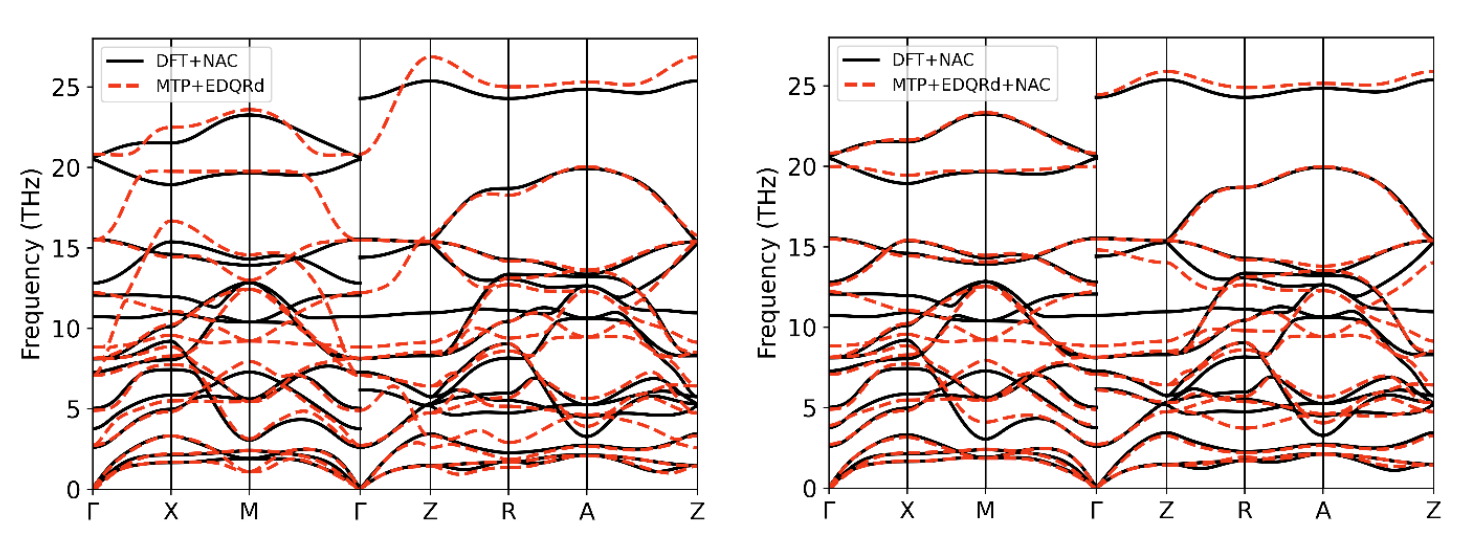
Phonon spectra of PbTiO₃ obtained using MTP+EDQRd without and with the non-analytical correction (NAC) calculated using the method proposed in the paper.
Overall, the proposed model and methodology extend both the range of systems that can be described using machine-learned interatomic potentials and the range of material properties that can be calculated with them, without requiring additional quantum-mechanical calculations.
15.09.2026