Multiscale modeling of molten-salt reactor coolants
Digital Materials has presented a new approach for modeling the thermophysical properties of advanced coolants for molten-salt reactors.
The paper Integrating moment tensor potentials with finite-element modeling for heat transfer prediction in FLiBe-based molten salt systems presents an end-to-end modeling approach combining molecular dynamics simulations using MTP machine-learned interatomic potentials with finite-element modeling. The developed methodology is aimed at accelerating the development of safe and efficient molten-salt reactors by complementing costly experiments with high-accuracy computational predictions.
The workflow begins with training MTPs on quantum-mechanical data for systems relevant to molten-salt reactors: fluoride salt melts, in particular FLiBe containing UF₄ nuclear fuel and LaF₃ as a model compound representing fission products. The trained potentials are then used to calculate a range of properties that determine coolant thermal-hydraulic behavior, including density, viscosity, diffusion coefficient, heat capacity, and thermal conductivity. The main simulation results are shown in the figure.
The workflow begins with training MTPs on quantum-mechanical data for systems relevant to molten-salt reactors: fluoride salt melts, in particular FLiBe containing UF₄ nuclear fuel and LaF₃ as a model compound representing fission products. The trained potentials are then used to calculate a range of properties that determine coolant thermal-hydraulic behavior, including density, viscosity, diffusion coefficient, heat capacity, and thermal conductivity. The main simulation results are shown in the figure.
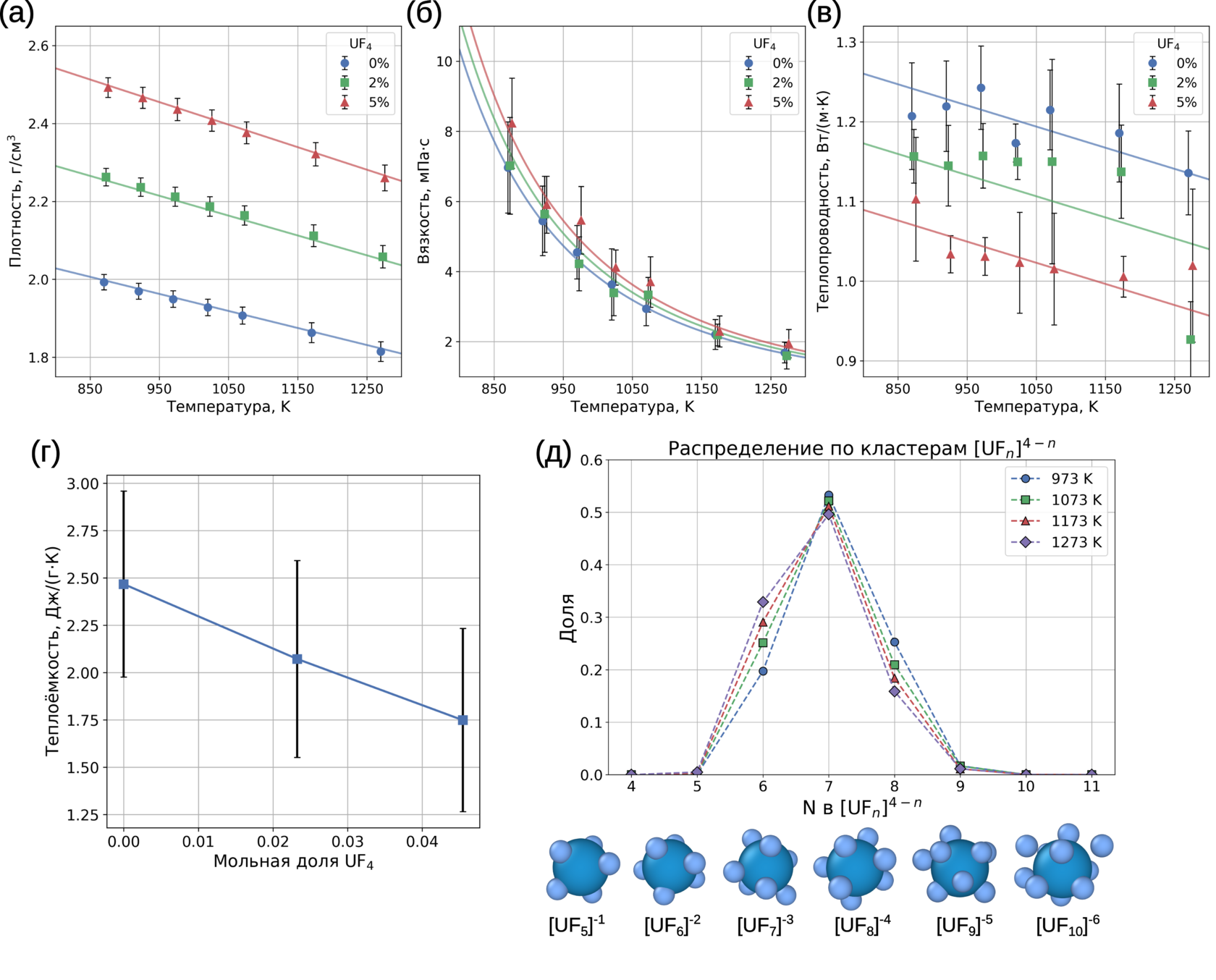
Properties of FLiBe (66:34) with added UF₄ obtained from molecular dynamics simulations using MTP. Temperature dependence of (a) density, (b) viscosity, and (c) thermal conductivity; (d) heat capacity as a function of the UF₄ mole fraction; and (e) cluster composition of the FLiBe–UF₄ melt as a function of temperature.
The calculated properties were compared with experimental data. The simulations showed a systematic overestimation of thermal conductivity and an underestimation of viscosity by approximately 20%. At the same time, the qualitative behavior of the systems was reproduced correctly: the addition of UF₄ and LaF₃ increased density and viscosity and reduced thermal conductivity.
Thus, despite errors in the absolute values of the calculated properties, the qualitative behavior of the system and the relative changes caused by the addition of fuel were reproduced correctly. The simulations also provided a qualitative explanation of the physical origin of the observed changes in molten-salt properties: heavy elements from the nuclear fuel and its fission products form heavy, slow-moving clusters that increase viscosity and reduce heat-transfer efficiency.
Next, our colleagues from the Institute of High Temperature Electrochemistry of the Russian Academy of Sciences developed a three-dimensional finite-element model of the experimental setup used to study molten salts for molten-salt reactors and the behavior of its components. The model was validated against experimental data and reproduced both the behavior of the molten salt in the setup and the corresponding heat flows. It was then used to model molten-salt systems that are difficult to study experimentally because of the presence of nuclear fuel.
Thus, despite errors in the absolute values of the calculated properties, the qualitative behavior of the system and the relative changes caused by the addition of fuel were reproduced correctly. The simulations also provided a qualitative explanation of the physical origin of the observed changes in molten-salt properties: heavy elements from the nuclear fuel and its fission products form heavy, slow-moving clusters that increase viscosity and reduce heat-transfer efficiency.
Next, our colleagues from the Institute of High Temperature Electrochemistry of the Russian Academy of Sciences developed a three-dimensional finite-element model of the experimental setup used to study molten salts for molten-salt reactors and the behavior of its components. The model was validated against experimental data and reproduced both the behavior of the molten salt in the setup and the corresponding heat flows. It was then used to model molten-salt systems that are difficult to study experimentally because of the presence of nuclear fuel.
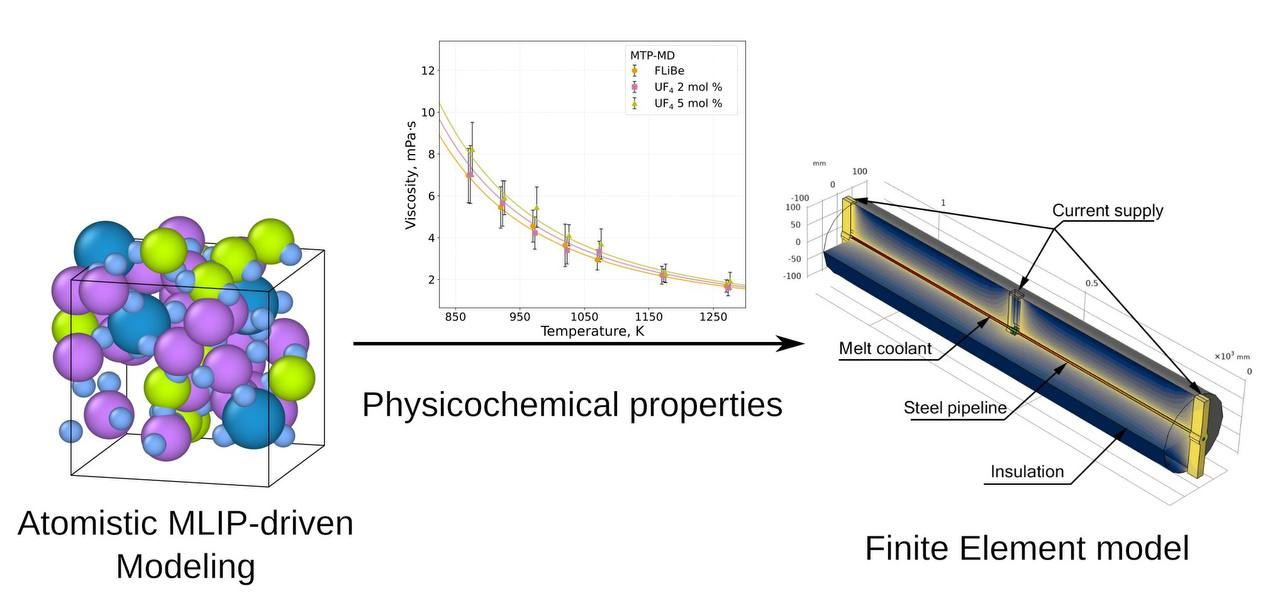
The simulations showed that heat-transfer efficiency in melts containing fuel and fission products decreases by 8–11% compared with pure FLiBe. The addition of nuclear fuel had a stronger effect on heat transfer than the presence of fission products.
Thus, the developed methodology complements costly high-temperature experiments and opens the way to rapid virtual prediction of the behavior of components in safe and efficient future molten-salt reactors.
Thus, the developed methodology complements costly high-temperature experiments and opens the way to rapid virtual prediction of the behavior of components in safe and efficient future molten-salt reactors.
04.09.2026